Every cafe racer build starts with a dream. A stripped-back frame. A set of clip-ons. Maybe a sketch on the back of a napkin. But the thing nobody talks about enough is where that dream actually takes shape.
Most of us start in a single-car garage stuffed with lawn chairs, Christmas decorations, and a workbench crammed into the corner. You know the drill. You’re trying to mock up a subframe while dodging a chest freezer. The lighting is awful. There’s condensation dripping onto bare metal parts overnight. And your welder keeps tripping the house electrics.
That’s not a workshop. That’s a compromise.
If you’re serious about building bikes, the space you work in matters almost as much as the parts you choose. And for a proper cafe racer workshop, a steel garage building is genuinely hard to beat. Here’s why.
What a Real Cafe Racer Workshop Demands
A cafe racer build is messy, physical work that swings between precision and brute force. One minute you’re carefully shimming a carburettor. The next you’re grinding welds on a loop frame with sparks bouncing off the floor.
That means your workshop needs to handle both ends of the spectrum. You need a clean zone for engine rebuilds, assembly, and parts storage. And you need a dirty zone for welding, cutting, grinding, and blasting. Mix those two up and you’ll spend more time cleaning contamination off freshly machined surfaces than actually building the bike.
The tools that dictate your space
Think about what a serious build actually requires. A MIG or TIG welder. A compressor running air tools and maybe a small blast cabinet. An angle grinder that throws sparks three metres. A drill press. A parts washer. Shelving stacked with labelled tubs of fasteners, gaskets, and shims.
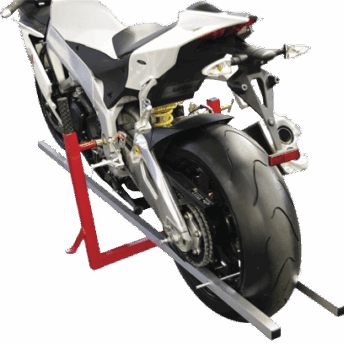
Now add the bike itself, sitting on a rear stand or a bench lift, with wheels, tanks, and bodywork scattered around it during a mock-up. You need room to walk around it. Room to step back and look at proportions. Room to wheel it outside for a test fit in daylight.
Forum after forum says the same thing. However big you think your workshop needs to be, double it. Free floor space around your tools matters just as much as the tools themselves.
Why Steel Wins Over Brick and Timber
Traditional brick garages are solid, sure. But they’re slow to build, expensive to extend, and you’re stuck with whatever internal layout the bricklayer gives you. Timber workshops look great on Instagram but they’re vulnerable to moisture, rot, and the kind of chemical exposure that cafe racer work dishes out daily. Solvents, fuel, degreasers, and oil mist are not kind to wood.
Steel is different. And the advantages line up almost perfectly with what motorcycle builders actually need.
Clear-span interiors
Metal garage buildings use cold-rolled steel frames that create wide, column-free internal spaces. No load-bearing walls chopping up the floor plan. No posts blocking the path between your bench and your bike lift. Just open, usable space you can arrange however the build demands.
That flexibility is massive. Workshop layouts evolve constantly. A project that starts as a simple seat-and-bars swap can escalate into a full frame-up restoration. Your building shouldn’t fight that progression.
Durability that suits a working environment
Galvanised steel doesn’t rot. It shrugs off the kind of humidity and chemical exposure that would wreck a timber structure within a few years. Quality steel garages are widely understood to deliver 50-plus year service lives with minimal maintenance, which is a compelling argument when you’re investing in a permanent build space.
There’s a safety angle too. Steel is non-combustible. That matters when your workshop contains fuel, solvents, a welder throwing sparks, and a grinder sending hot swarf across the room. UK building regulations actually treat non-combustible materials more favourably for detached garages near boundaries, which can simplify your planning situation.
Speed and future-proofing
A prefabricated steel garage arrives as an engineered kit. The frame, cladding, doors, and fixings are manufactured off-site and assembled in days rather than weeks. Compare that with the months a traditional masonry build can take, especially once you factor in British weather delays.
And if your ambitions grow, steel structures are easier to modify. Adding insulation, fitting a mezzanine for parts storage, or upgrading the electrical layout is straightforward compared to retrofitting a brick or block building.
Getting the Layout Right
For a two or three bike workshop, a footprint around 6m × 9m is a solid starting point. That gives you enough room for a dedicated fabrication area, an assembly zone, a decent bench, and storage without everything being piled on top of itself. If space and budget allow, going bigger is never a mistake.
Put your dirty work near the main door. Welding and grinding close to ventilation and an exit route makes sense for fume extraction and fire safety. Keep your clean assembly area at the opposite end, away from sparks and dust. The compressor sits between the two zones, ideally with air lines running to both areas via ceiling-mounted reels.
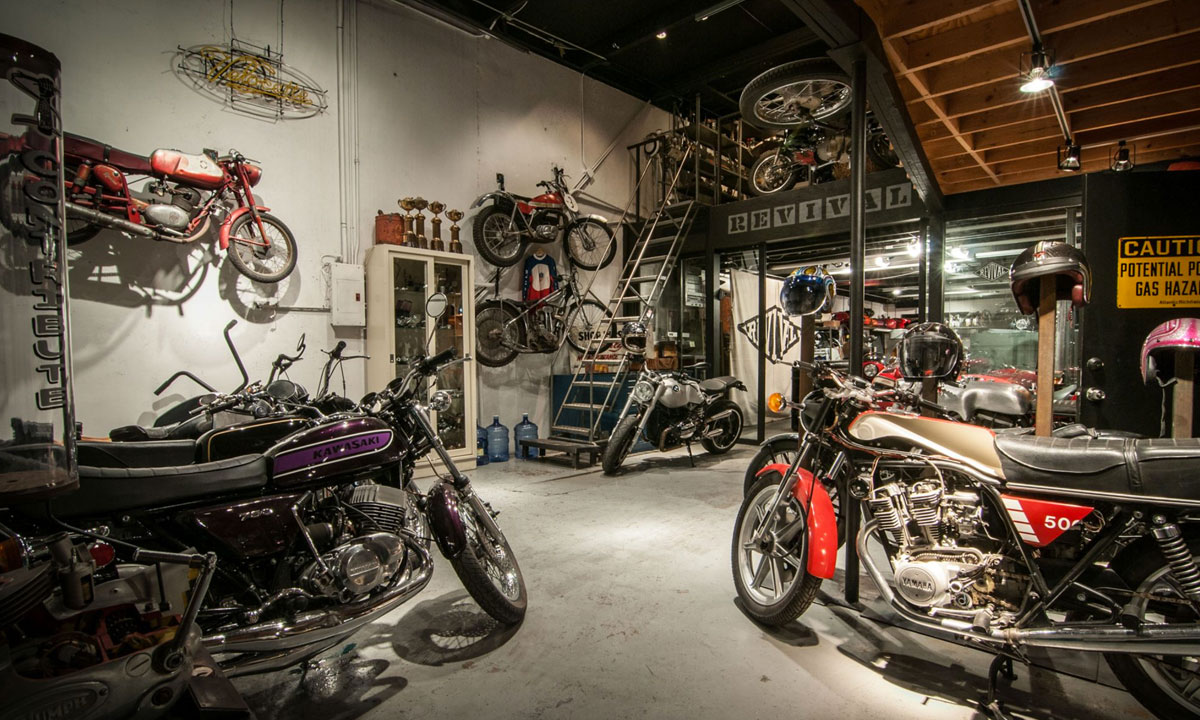
A mezzanine is worth serious consideration. It lifts parts storage, documentation, and overflow kit off the workshop floor, keeping the ground level open for the work that matters. Some builders even use the mezzanine as a small lounge or display area, which fits the cafe racer culture perfectly.

Insulation and Ventilation for UK Conditions
An uninsulated metal building in a British winter is miserable. Condensation forms on cold steel surfaces overnight and settles on every exposed component. Bare crankcases, fresh machining, polished alloy — all of it starts showing surface corrosion disturbingly fast.
Insulated composite panels for walls and roof solve this. Paired with a vapour barrier and a modest heating setup, an insulated steel workshop stays dry and usable year-round. That alone protects hundreds or thousands of pounds worth of parts and tools from moisture damage.
Ventilation matters equally. Welding fumes, grinding dust, and paint overspray need to go somewhere. An extraction fan pulling air out, combined with a filtered intake on the opposite wall, creates the cross-flow that keeps your air clean without turning the building into a wind tunnel.
Planning Permission: Simpler Than You Think
In England, a detached garage or workshop usually falls under Permitted Development rights, meaning no planning application is needed. The main conditions are straightforward. The building must be single-storey, sit behind the principal elevation of your house, stay under the height limits, and not cover more than 50% of the land around the original dwelling.
Building regulations typically don’t apply to a detached garage under 30 square metres, provided it’s either at least one metre from the boundary or built from substantially non-combustible materials. Steel ticks that box neatly.
If your property is listed, sits in a conservation area, or is subject to an Article 4 direction, check with your local planning authority before committing. The rules are different and the penalties for getting it wrong are real.
The Aesthetic That Already Fits
Cafe racer culture runs on a stripped-back, industrial aesthetic. Raw materials. Exposed mechanical beauty. Function over decoration. A steel workshop doesn’t need to pretend to be something it isn’t.
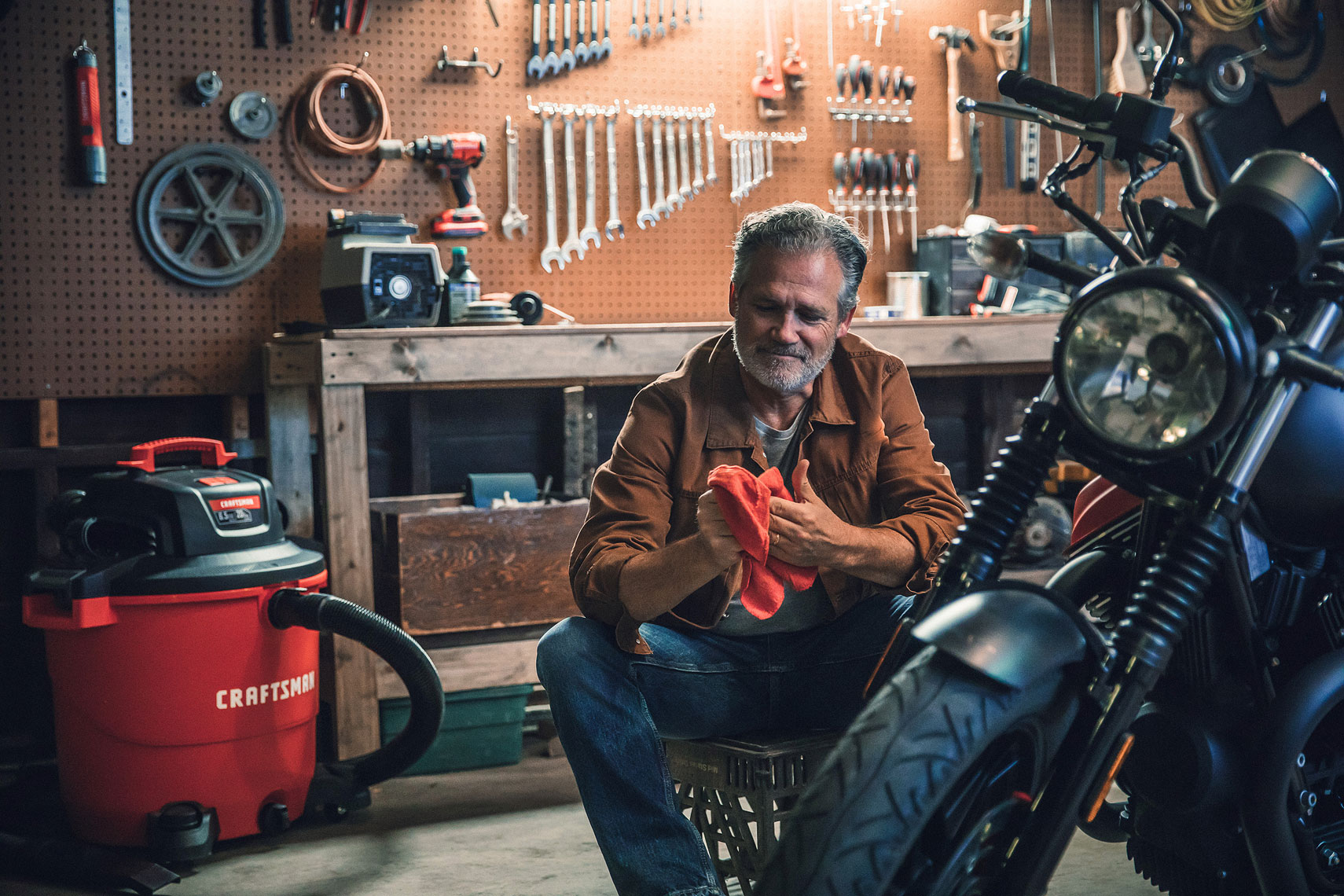
Pegboards loaded with tools. Industrial pendant lighting. A vintage race poster on the wall. The bike sitting centre-stage under good light with its engine cases gleaming. That atmosphere comes naturally in a steel building. It’s honest space for honest work, and it looks the part without trying.
Your Workshop Checklist
Before you commit, nail down these essentials. Dimensions that give you room to grow. Insulated panels for year-round use. A reinforced concrete slab foundation. Enough electrical capacity for a welder, compressor, heater, extraction, and lighting on separate circuits. Roller door access wide enough for comfortable bike movement. And a ventilation plan that handles fumes, dust, and moisture.
Get those right and you’ll have a workshop that doesn’t just store your cafe racer. It makes the build possible.